
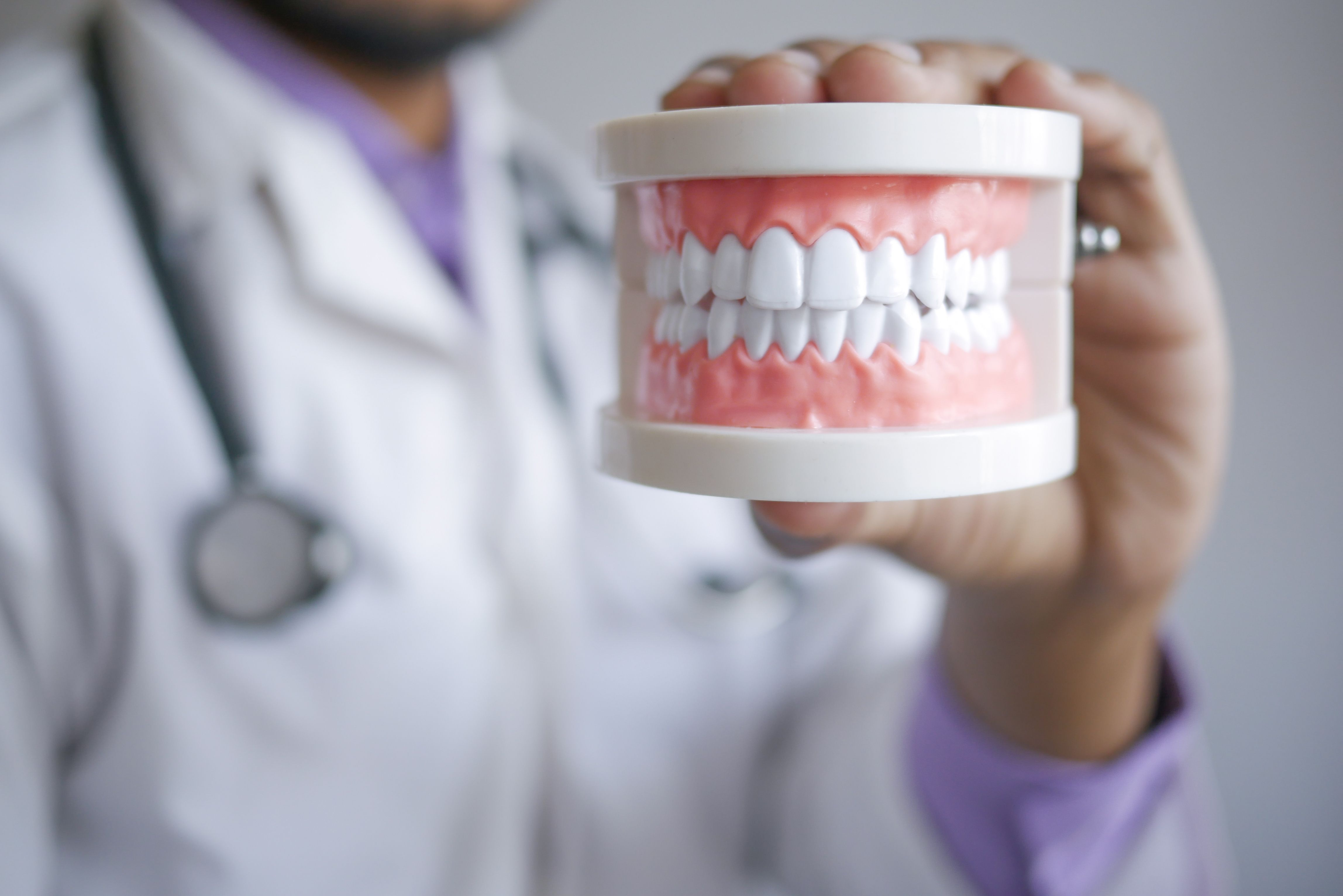
Getting new teeth or dentures can leave you unsure who to see — a dentist, dental hygienist, oral surgeon, or dental prosthetist. Each of these professionals plays a distinct role in oral healthcare. So when you want new teeth, improved chewing ability, or your dentures repaired or replaced, should you book with a general dentist or a dental prosthetist?
Understanding the difference between a dental prosthetist vs dentist will help you make the right choice. Both are equally qualified, registered professionals — but each undergoes different training and performs different tasks in practice. Knowing which one you need will save you time and prevent unnecessary procedures.
Key Differences Between a Dental Prosthetist and a Dentist
To make an informed decision about your oral healthcare provider, it helps to understand exactly how these two professions differ.
1. Educational Paths and Training
A dentist completes many years of university and clinical education in general dentistry, covering diagnosis and treatment of a broad range of dental problems — disease, damaged teeth, and various surgical procedures.
A dental prosthetist follows a different path. They first gain technical knowledge in the design and construction of dental prostheses, then complete clinical training specific to dental prosthetics. This combination allows a dental prosthetist to examine patients directly and specialise in the design, construction, adaptation, maintenance, and repair of removable dental prostheses such as full dentures.
2. Scope of Clinical Practice
A dentist's services include treating decay, fillings, root canal therapy, periodontal treatment, extractions, and certain crown and implant procedures.
A dental prosthetist has a narrower, more specialised scope: making and repairing removable prosthetic appliances such as full dentures, partial dentures, immediate dentures, and implant-retained overdentures. It's uncommon for a dental prosthetist to perform fillings, cleans, or extractions.
3. Hands-On Fabrication and Technical Control
This is one of the most practical distinctions. After an appointment, a dentist typically sends impressions or scans to an external dental laboratory, where a technician constructs the dentures.
A dental prosthetist, by contrast, is trained in both clinical assessment and technical construction. They personally assess bite, jaw movement, and facial features to design and fabricate personalised dentures — often without outsourcing the process to a separate lab.
4. Do You Need a Referral to See a Dental Prosthetist?
In Australia, dental prosthetists are independent practitioners. You generally don't need a referral or a prior dentist visit — you can contact a denture clinic directly for an appointment.
That said, a dental prosthetist will often collaborate with a dentist when a patient needs several types of treatment. For example, if you need immediate dentures, your prosthetist can design them in advance, ready to be fitted as soon as your dentist completes the extractions.
5. Cosmetic and Functional Customisation
Dentists focus on treating oral health issues — decay, gum disease, infection — while also considering the aesthetics of your smile as part of treatment.
Dental prosthetists focus specifically on the design and aesthetics of removable prostheses. Denture shape, shade, and fit are tailored to your facial structure, skin tone, and natural features, with particular attention to how well the dentures support your lips and cheeks. This is especially true of advanced systems like BPS Precision Dentures, which use a facial-analysis approach to denture design.
6. Dental Prosthetist vs Dentist: Cost and Timeframe
Because a dentist typically outsources denture fabrication to an external laboratory, there can be added laboratory costs and extra time spent coordinating between the clinic and the lab.
Many dental prosthetists specialise solely in removable prosthetics and can manage most or all of the process themselves, working closely with a laboratory only when needed. For repairs, adjustments, or relines, a dental prosthetist can often assess and resolve the issue more efficiently than a dentist would.
Dental Prosthetist vs Dentist: Who Should You See?
Your specific need determines the right provider:
Your Need | Who to See |
Tooth decay, fillings, root canal, gum disease, extractions | Dentist |
New, replacement, or immediate dentures | Dental Prosthetist |
Denture repairs, relines, or adjustments | Dental Prosthetist |
Implant-retained overdentures | Dental Prosthetist, often alongside a dentist or specialist |
General oral health checkups | Dentist |
If your need involves general dental health — decay, periodontal disease, fillings, root canals, or extractions — see a dentist. If you need dentures designed, fitted, adjusted, repaired, or maintained, a dental prosthetist is your best option.
Frequently Asked Questions
Can a dental prosthetist do dentures without a dentist? Yes. In Australia, dental prosthetists are independent, registered practitioners and can provide denture care without a referral from a dentist.
Is a dental prosthetist cheaper than a dentist for dentures? Often, yes. Because many prosthetists handle both the clinical fitting and the fabrication themselves, you can avoid the extra laboratory fees and coordination time involved when a dentist outsources the work.
Does a dental prosthetist do the same job as a dental technician? No. A dental technician typically only fabricates prostheses based on impressions sent by a dentist. A dental prosthetist is trained in both patient assessment and technical construction.
Looking for Personalised Denture Care in Adelaide?
If you're looking for personalised denture care in Adelaide, SA Precision Dentures can help. With more than 30 years of experience, Paul Norris combines technical and clinical expertise to provide customised denture solutions — and was among the first dental prosthetists in South Australia to become accredited in the Biofunctional Prosthetic System (BPS).
Contact the friendly team at SA Precision Dentures to arrange a consultation and discuss your denture needs.